|
Other Berchtesgaden Area
Buildings
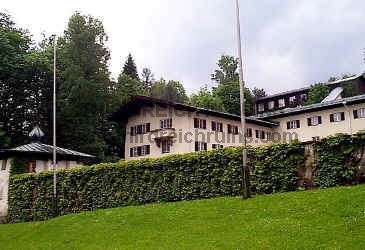
After the complex on the Obersalzberg assumed much
greater importance in the Third Reich government, Hitler decided to build a second
government seat in the Berchtesgaden area. This second Reichskanzlei (Reichs
Chancellery) building and complex was built in 1936-37 in Stanggass, just northwest of
Berchtesgaden (the main Reichskanzlei being the monumental edifice in Berlin). This
Berchtesgaden Kanzlei was surrounded by a small complex of staff and security buildings,
and served as a diplomatic center. The U.S. Army took the site over in 1945, and it
served as the headquarters for the Berchtesgaden Recreation Area and Armed Forces Recreation Center
until 1995.
Since the AFRC Berchtesgaden closed down in late 1995, the complex stood empty
for several years, the
buildings locked. Around 2005 the Reichskanzlei
complex was purchased by a private concern and renovated for apartments. In August 2008 a marker
explaining the significance of the building was erected on the site.

|
|
The Watzmann
Mountain, symbol of the Berchtesgadener Land, towers in the background.
(top-left
- period postcard; top-right - Dokumentation Obersalzberg; middle-left - Bayerische
Staatsbibliotech; middle-right - courtesy Clarke Family Archives; bottom
left - "Ich kämpfe," Munich, 1943; bottom-right - period
painting) (Google
Maps link) |

|

|
 |
 |


|

|
On the
left, a period postcard, with the corresponding view today. |
|

|
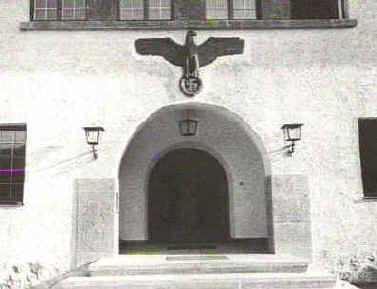
| On the exterior, only
the Hoheitszeichen national insignia (minus its swastika) remains of the former owners.
(Bayerische Staatsbibliotech) |
 |
 |
| Field
Marshall Wilhelm Keitel greets Hans Lammers, chief of the Reichskanzlei,
in front of the main entryway. The original light fixtures remain.
(U.S. National Archives) |

|

|
Allied forces use
captured Nazi staff cars for transportation to their headquarters at the Stanggass Kanzlei
complex, May 1945. Before the arrival of the U.S. Army, the Kanzlei staff
had abandoned the complex and retreated to the Hintersee,
west of Berchtesgaden. ("The Epic of the 101st Airborne," 101st Airborne
Division Public Relations Office, Auxerre, France, 1945) |

|

|
In May
1945 Nazi propagandist Julius
Streicher was captured by soldiers of the U.S. 101st Airborne
Division, who detained Streicher for a time at the Stanggass Kanzlei. The
small doorway seen in the background of the period photo is the doorway to
the left in the modern view. (U.S. National Archives, RG 111SC) |
 |
 |
| The
monumental aspect of the structure continued on the interior, with red
marble columns and arched ceilings in the entry foyer (left above), and
a large Great Room with a fireplace and decorative paneling. The light
fixtures and some of the furniture pieces are original. On the left
below, Hitler congratulates Generalfeldmarschall Wilhelm Keitel on his 40 years of military service
in 1941, in front of the Große Halle fireplace. (Bundesarchiv) |
 |
 |

|

|
Included in the
Kanzlei complex were houses for Generalfeldmarschall Wilhelm Keitel, Chief of Staff
of the Armed Forces, and Generaloberst Alfred Jodl, Chief of the Operations Staff.
This is the Keitel-Haus, shown (left) as it appeared in the early 1950s
under AFRC control, when it was called the Pershing House, and (right) as
it appeared in 2001 (before renovation). (1950s photo
courtesy Clarke Family Archives) |
|

|
 |
|
The nearby Jodl-Haus (called
Haus Edda) was
somewhat smaller (see the 1945 photo below). In 2006 the Jodl-Haus was
torn down, and a new house built on its foundation (seen on the right
above). |

|

|
The Jodl-Haus (left)
and Keitel-Haus (right) both appear in this photo, taken 15 May 1945. The
occasion was a visit by Gen. Omar Bradley, who presented awards to several
soldiers of the 101st Airborne Division. (U.S. Army
photo) |

|

|
The
Keitel-Haus was renovated about 2004 and is now a private
residence. ("The Epic of the
101st Airborne," 101st Airborne Division Public Relations Office, Auxerre, France,
1945) |
-

|

|
In
common with most of the buildings on the Obersalzberg (and some others in
Berchtesgaden), the Kanzlei complex had an underground air-raid
shelter tunnel. In contrast to many of the other area tunnel systems,
this elaborate complex was completed and in service during the war. The
tunnel system is entered from the basement of a short corridor
between the two main buildings of the Kanzlei complex, and a multi-level staircase leads down to the main
tunnel area. At the bottom of the staircase (lower right), a wall marking
directed the correct way back to the service buildings of the Kanzlei
("only for employees of the Reichskanzlei"). |
 |


|


|

|
Various
wall markings directed personnel to Sections (Abteilungen) A-D, and
to the Latrines (Aborte), "at the end of the main tunnel in
Section C." On the left below is one of the latrine rooms, stripped
after the war. The room on the right below originally mounted a large
generator for electrical power.
(above
left, bottom image - courtesy Vis Kimenis, LTC USA (Ret.) |
 |
 |

|

|
Above -
a Machinery Room originally housed ventilation equipment. Below - the ventilation
ducting (left) and air filters (right) were found in the Unterstollen,
an auxiliary tunnel running beneath the main tunnels. (below
- courtesy Vis Kimenis, LTC USA (Ret.) |
 |
 |

|

|
|
Left - A side tunnel leads to a
shaft that may have been for draining excess water to the outside (doorway
on the right), and a blocked doorway (on the left) that may originally
have led to another exit. The area on the right, near the final exit,
would have housed a machinegun position to guard the tunnel area leading
from the lower exit by the railroad tracks (seen below). The marking on
the wall originally read "zum Ausgang - to Exit," with
an arrow pointing to the left. |

|

|
This
secondary exit is in the hillside behind the main Kanzlei building. |
 |
 |
 |
| The
final
exit at the level of the railroad tracks in the valley behind the
building was buried for many years, but was reopened and the doorway
renewed in 2014 (left). This exit would have allowed personnel to
enter/exit the Kanzlei through the tunnel system, directly from/to the
adjacent rail line, without being observed. The structure in the center and right photos was
a concrete top for a ventilation shaft for the tunnel system, on the
hillside behind and above the tunnel exit at the left. (center
and right - courtesy Ralf Hornberger) |
-

|

|
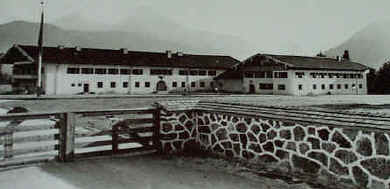
A military barracks
complex was built nearby in Strub in 1937-38 for the 2nd Battalion of Gebirgsjägerregiment 100, and was cited in a 1940 book on
German art as a classic example of harmonious military architecture blending into the
surroundings. Although its official name was "Adolf Hitler
Kaserne," the post was commonly called the
Gebirgsjäger Kaserne (Mountain Troops Barracks). The post was used by the U.S. Army until
1995 but has now been turned back over to the Germany military
(1942-dated postcard in author's collection) (MapQuest
Map Link) |

|

|
The period insignia over the front
door has been modified so that the eagle holds an edelweiss flower (symbol of the Mountain
Troops), instead of a swastika. |
The Lion Monument memorializes all
those of the Mountain Troops who have lost their lives in war, in particular the Mountain
Troops of World War II. |
 |
 |
| On the
left above, Gebirgsjäger troops from the Strub Kaserne parade through
Berchtesgaden on Hanielstraße. By chance, my father photographed this same view
in the spring of 1946 (on the right). The house at Am Kugelfeld still stands
(below). |
 |
-

|

|
A Sports School for the Bund
deutscher Mädel (BDM - League of German Girls - girls' Hitler Youth) was built in the
Berchtesgaden suburb of Strub in 1938. The complex serves today as a home for the elderly
(Altenheim Insula). Click here to see
an air-raid bunker nearby. (MapQuest
Map Link) |
This building, located on the road
to the Scharitzkehlalm, was
a water house reportedly used as a cooling house to store milk from Martin Bormann's
herds that grazed in the Scharitzkehl pasture. Although not co-located, it was part of the
Gutshof complex. (A
wooden addition was built on in 2014.) (MapQuest
Map Link) |
-

|

|
The Adolf Hitler
Jugendherberge (Youth Hostel) was also built in Strub from 1935-1938. It was designed by architect Georg
Zimmermann. The building still serves as a youth activities center today.
(from
Werner Rittich, "Architektur und Bauplastik der Gegenwart," Berlin, 1938
(author's collection)
Note: As of July 2011, renovation is
changing the appearance of the Jugendherberge complex. The small garage
building and wall in front have been removed. The renovation, finished in
September, was a radical change to this historic structure. It now looks
like this, complete with fake painted-on window shutters, modern windows
and entry doorway, and a metal fire
escape. |
 |
 |
 |
 |
| Period
postcard views of the Adolf Hitler Jugendherberge. The view on the right
below, which shows the other side of the building, shows the Watzmann
mountain in the background. (author's collection)
(MapQuest
Map Link) |
 |
 |

|

|
In the period view,
Hitler Jugend boys play behind the Jugendherberge. |

|

|
Another view of the
Adolf Hitler Jugendherberge. (from Frau Prof. Gerdy Troost, "Das Bauen im
neuen Reich," Vol. 1, 4th edition, Bayreuth, 1938) |

|

|
Hitler
visited his name-sake Jugendherberge in October 1936, as seen in this
photo from the Illustrierter Beobachter newspaper of 29 October
1936. |
 |
 |
| Below -
the original doors of the Jugendherberge and original wood carvings
decorating the façade. (left above - "Moderne Bauformen," 1937) |
 |
 |
 |
 |
| The
entry hallway featured a display of Nazi flags - these are naturally
gone today. Little else has changed - even the stairway railings remain
original (but - the 2011 renovation radically changed this view). ( |

Architectural model of the Adolf Hitler
Jugendherberge. The main building is on the left; the other
two buildings also still exist. (from Official Catalog of the 1st German
Architecture and Crafts
Exhibition, in the Haus der Deutschen Kunst in Munich,
January-March 1938 (author's collection)

Side plan view from a period
architectural magazine. ("Moderne Bauformen," 1937)
-
|

|
This small pressed paper
disc portrays the Adolf Hitler Jugendherberge. It was one of a
series showing youth hostels across Germany, given as a token to those
who contributed to the Winterhilfswerk Nazi welfare relief.
(author's collection)
Click here to see a
WHW disc showing the Baldur von Schirach Jugendherberge at Urfeld am
Walchensee.
|
-
 |
 |
| During
the early 1930s, before his fame precluded this, Hitler enjoyed long
walks in the Obersalzberg area. One of his favorite walks was along the
Carl-von-Linde-Weg, from the area below the Platterhof Hotel to the
Hochlenzer Gasthaus. The photos above show Hitler at Hochlenzer, while
those below show the approximate scenes today. On the left above,
Hitler's adjutant Wilhelm Brückner opens the gate while Youth Leader
Baldur von Schirach (in Lederhosen) comes up behind. On the right
Hitler appears to be holding backpack straps, but this is actually his
ever-present dog whip which he has looped around his shoulders. (Heinrich Hoffmann, "Hitler in seinen Bergen," Munich, 1938,
and "Hitler, wie ihn keiner kennt," Berlin, 1932) |
 |
 |

|

|
|
Hitler in different poses at
Hochlenzer. On the left, he sits at an outdoor
table with Bruno Buchner and his wife, proprietors of the Platterhof Hotel. On
the right, Hitler in a more pensive mood. (period postcard) |

Hitler greets the owners and staff of
Hochlenzer during a visit in the 1930s. (period postcard)
-
|

|
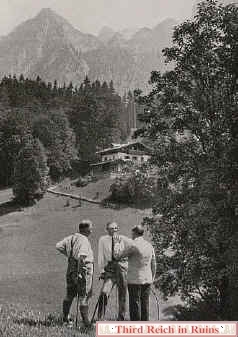
Dietrich Eckart was a German
Nationalist writer and early member of the Nazi Party, who considered himself Hitler's
mentor. While hiding from the Weimar government Eckart stayed in a cottage called the
Göllhäusl, in the Hinterbrand area near the Obersalzberg. This house was later annexed
to the Platterhof as a guest lodging. The view above shows (left-right): Hermann Göring, Reichs War
Minister Werner von Blomberg, and Hitler visiting the Eckarthaus, ca. 1935.
(from
Heinrich Hoffmann, "Hitler in seinen Bergen," Munich, 1938 (author's collection) On
the right, the Dietrich Eckart house today. Used by the U.S. Army AFRC as a youth
sports retreat called "Hinterbrand Lodge," the house was closed in
2013, the final Berchtesgaden area building used by AFRC to be returned to German
control. Comparison to the period postcard view below shows some of the
changes that were made to the building under U.S. Army control. (MapQuest
Map Link) |
 |
 |

The Göllhäusl as it appeared in the
1940s. (author's collection)

|

|
|
The interior of the house has been
changed as well, but it still retains some original features. The layout
of the original Dietrich Eckart Stube (period postcard view, left above)
can still be seen in the house manager's office today (along with original
carved wood paneling). Some original wood carvings from the 1930s also
remain - on the left below is an original carving on the door into the
Dietrich Eckart Stube, and the ceiling beam in the main dining room
retains partial carvings that can be read as "Auf wunsch des führers
... Im jahre ... (the rest is chiseled out or too defaced to read
today). (Many thanks to Frank Huber for permission to photograph
inside, and for additional info.) |
 |
 |
-
|

|

|
|
The Hitler-Göring-Blomberg
group seen above also visited the
Brüggenlehen farm, just down the road in the Vorderbrand area. From left
to right - Dr. Karl Brandt (partially hidden behind him appears to be
Max Amann), Göring, Joachim von Ribbentrop (in rear), Hitler, von
Blomberg, Wilhelm Brückner (Hitler's adjutant). ("Adolf Hitler
- Bilder aus dem Leben des Führers," Cigaretten-Bilderdienst, 1936;
modern photos courtesy Ralf Hornberger) |
 |
 |
|

|

|
|
The Gasthof Vorderbrand was
another favorite eatery for a Hitler visit in the early 1930s. The Stube,
or Dietrich-Eckart-Zimmer, preserves a nearly identical appearance from the 1930s (the small
swastika pennant hanging in the corner is naturally gone, and the furniture has
been updated). (Florentine Hamm, "Obersalzberg,
Wanderungen zwischen Gestern und Heute," Munich, 1941) |
-
|

|

|
|
Dietrich Eckart died in December 1923 in
this house in Berchtesgaden, called the Sonnblickhäusl (now a private
residence). (Florentine Hamm, "Obersalzberg,
Wanderungen zwischen Gestern und Heute," Munich, 1941) |
-
 |
 |
 |
| Dietrich
Eckart
was buried in the Altfriedhof cemetery in Berchtesgaden. On the left is
a 1935 photo of his decorated grave; in the center from about 1936; on
the right a recent photo. Note the difference in the lettering styles
between then and now. At some point, possibly in 1945 during the
American occupation, Eckart's name was ground off his marker, and was
later recarved in a different style (this can also be seen from the type
of stone finish on the front and back of the marker today). (Click here
and here to visit other sites
associated with Dietrich Eckart.) (left
- author's collection; center - Florentine Hamm, "Obersalzberg,
Wanderungen zwischen Gestern und Heute," Munich, 1941) |
-
|

|

|
|
The former
Dietrich-Eckart-Krankenhaus as it appeared in 2009. |
|

|

|
|
The cupola in the angle between
the buildings (seen in the right-hand photo) has a unique wind vane -
see below. (Note: In 2013 this wind
vane disappeared from the roof.) |

|

|

|
|
At the rear of the complex is an
enclosed courtyard that leads to a large open area in back, with wall
murals painted on the stairwell housings. The marble staircase below is
one of the few period items still left inside. This staircase is at the
corner of the wings seen below, behind the tall windows. |
 |
 |
|

|

|
|
The murals, which feature
traditional Bavarian alpine agricultural and family themes, were painted
by Berchtesgaden artist Maria Harrich. They may have been painted (or
repainted) after the war. Harrich also painted the wall murals in the
main hall of the Berchtesgaden
Bahnhof. |

SS Chief Heinrich Himmler did not have a
house on the Obersalzberg, but he did maintain a
house in Schönau
for his mistress Hedwig Potthast. This house, called the Schneewinkllehen,
was a vacation home
for Sigmund Freud in the 19th century. The house is
now private property.
 Continue to see further
Berchtesgaden area buildings and sites.
Continue to see further
Berchtesgaden area buildings and sites.
Visit
Berchtesgaden area anti-aircraft (Flak) positions
Visit the Berchtesgadener
Hof hotel, then and now
Continue to the Obersalzberg sites - Hitler's
Berghof, Bormann's and Göring's houses, Platterhof, Gästehaus and Kampfhäusl, Hotel Zum Türken,
Gutshof and Teehaus,
Kehlsteinhaus, SS barracks, bunker system,
SS guard houses,
miscellaneous Obersalzberg
buildings.
 Return to the Third Reich in Ruins homepage
For further information, including Internet links, check
the Bibliography page. I am sincerely indebted to Florian Beierl
of the Archiv Obersalzberg, who identified the modern locations of some of these sites for
me.
 |
My guide
book to Third Reich sites in the Berchtesgaden and Obersalzberg area has
been published by Fonthill Media.
"Hitler's
Berchtesgaden" is available at Amazon and other retailers (the
Kindle version is also available from Amazon). |
Guided Tours
For personal guided tours in
English of Third Reich sites in Berchtesgaden and on the Obersalzberg (and other
local sites) from a certified and accredited local tour guide, contact:
Tom Lewis
+49-(0)1602-641-800
atobersalzberg@sky.com

BEGAFILM
- Historic Films About Berechtesgaden and the Obersalzberg
|