|
Berlin -- Reichssportfeld
and 1936 Olympics Site
The area where the
Olympic Games were held in Berlin in August 1936 was known as the Reichssportfeld. It
included the Olympic Stadium and several other sports fields and buildings. Much of this
area remains today as it did in 1936, still a sports center.
Click here to
visit the Haus der Deutschen Sport and the site of the 1936 Olympic Village.

|

|
Architectural model
(left) and aerial photo (right) of the Reichssportfeld, showing the sites that appear
below. The Olympic Stadium is at the center, with the Olympic Bell Tower on
the other side of the adjacent sports field. The
Dietrich-Eckart-Bühne Thingplatz
appears at the lower left (lower center in the aerial photo).
(left - from Official Catalog of the 1st German Architecture and Crafts
Exhibition, in the Haus der Deutschen Kunst in Munich,
January-March 1938; right - 1936 dated postcard; both in author's collection) |

|

|
The
Olympic Stadium, designed by Werner March, has the same general
appearance as it did in 1936 (on the exterior), although
one obvious change was the removal of the curved swastika symbol from the right-hand tower. More extensive
changes came from
2001-2006 as the stadium was remodeled and modernized, altering the inside
considerably and the outside to a lesser extent. These photos show the
Podbielski Oak Tree, a tree that was left standing during the stadium
construction in honor of Viktor von Podbielski, one of the original
planners for an Olympic Stadium and Olympic Games in Berlin. (Werner Rittich, "Architektur und Bauplastik der
Gegenwart," Berlin, 1938) |
-
|

|

|
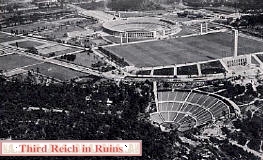
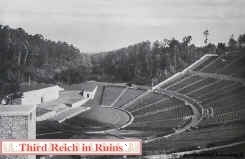
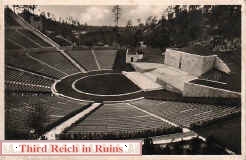
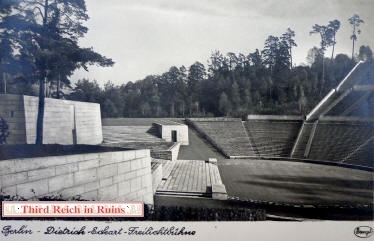
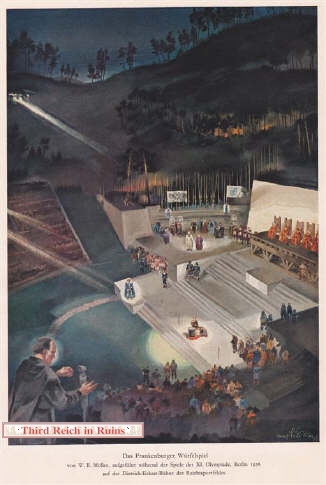
The
Dietrich-Eckart-Bühne was an amphitheater built in the "Thing"
style,
near the Olympic Stadium. It is known today as the Waldbühne, and is used for
rock concerts. (above left - Werner Rittich, "Architektur und Bauplastik der
Gegenwart," Berlin, 1938; others - period postcards). For another period photo, see http://www.silentwall.com/SceneryBuildings28.html. |
 |
 |
|

|

|
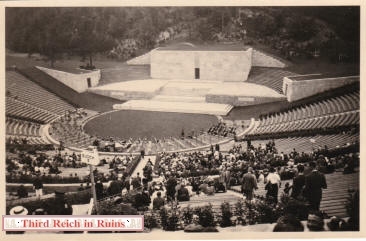
| Looking
down on the Dietrich-Eckart-Bühne from the Olympic Bell Tower. (from
a period postcard) |

The
Dietrich-Eckart-Bühne in use during the 1936 Olympics. ("Olympia,"
1936)

|

|
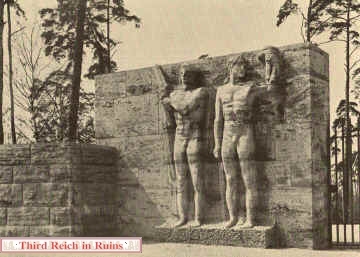
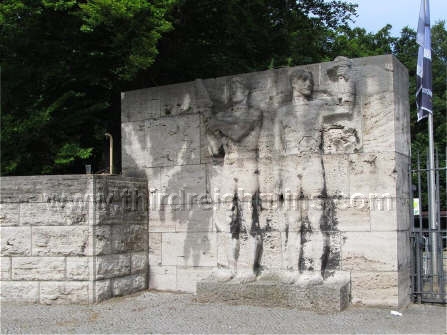
Entrance to the
Dietrich-Eckart-Bühne. (Werner Rittich, "Architektur und Bauplastik der
Gegenwart," Berlin, 1938) |
-

|

|
The
Glockenturm (bell tower) overlooks the large open sports field (Maifeld) adjacent to the
Stadium. The tower contained the Olympic Bell, which was inscribed
"Ich rufe die Jugend der Welt" (I call the youth of the world). The tower was burned out at the end of the war and blown up by
the British occupying forces in 1947, and rebuilt in 1962. Today the tower contains a reproduction of the bell; the original
is displayed outside the stadium itself (see
below). (Werner Rittich,
"Architektur und Bauplastik der Gegenwart," Berlin, 1938)
|
-

|

|
Beneath
the Bell Tower is the Langemarck
Halle, dedicated to the mythic cult of German student soldiers who were killed
during the battle of Langemarck
(West Flanders, Belgium) in November 1914 (World War I). Long closed to
the public, the Langemarck Halle was reopened along with the remodeled
Stadium, amid some
controversy, since the original martial inscriptions remain on the walls.
Below, Hitler visits the Langemarck Halle during the Olympic Games in
August 1936. (Bundesarchiv)
|

|
|

|

|
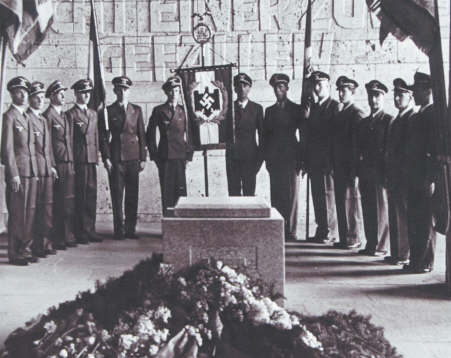
The Reichssportführer
(Leader of German Sports) Hans von Tschammer und Osten died in Berlin in
March 1943. Since he had been one of the principal organizers of the 1936
Olympics, his ashes were interred in a shrine in the Langemarck Halle on 2
May 1943. (The shrine no longer exists, nor does the barred doorway seen
in the period photo above.) (Bundesarchiv)
|
|
|

|

|
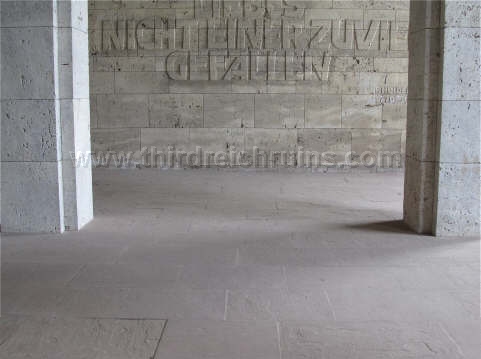
A Third
Reich period memorial inside the Langemarck Halle. The interior walls seen
in the period photos were removed to install the modern elevator. (Official
Report, the XIth Olympic Games, Berlin 1936 (Berlin, 1937)
|
 |
 |
| On the
left, men from the Labor Service (RAD) guard the Olympic Bell on its
journey from the foundry to the Bell Tower. On
the right, a model of the bell showing the Brandenburg Gate side. (Official
Report, the XIth Olympic Games, Berlin 1936 (Berlin, 1937) |
 |
 |
 |
| The
original 1936 Olympic Bell is now on display outside the Olympic
Stadium. The bell has a German eagle holding the five Olympic Rings in
its talons on one side, and the Brandenburg Gate on the other. The rim
displays the Olympic motto "Ich rufe die Jugend der Welt" (I
call the youth of the world). The bell
also had two swastikas cast into the rim - these are still partially
visible (see here). The bell
was damaged during the war when it was accidentally struck by an
anti-aircraft round fired at Allied bombers overhead. A long crack
passing through the bell was the result of its falling to the ground
when the bell tower was destroyed by British forces in 1947. |

|

|
Above, Adolf
Hitler leads the delegation of sports officials and foreign leaders into the Olympic
Stadium for the 1936 Olympic Games. Below, the German athletes march in, led by flag-bearer Hans
Fritsch (track and field events). The interior modernization is evident
with new seating and sun screens. (above
- National Archives, Record Group 242HB; below - Hans
Quassowski, ed., "Zwölf Jahre: 1.Kompanie Leibstandarte SS Adolf Hitler,"
Rosenheim, Deutsche Verlagsgesellschaft, 1989) |
 |
 |

Visible in the period photo above is
another innovation of the Berlin Olympic Stadium:
an electronic announcement and score board, located opposite the Flame Cauldron.
The renovations removed the stone towers on either side and substituted a
digital board.
(Official Report, the XIth Olympic Games, Berlin 1936 (Berlin, 1937)
 |
 |
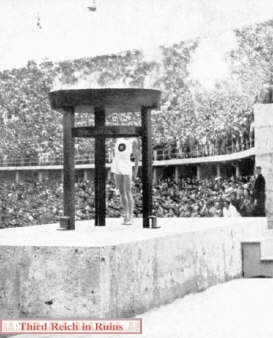
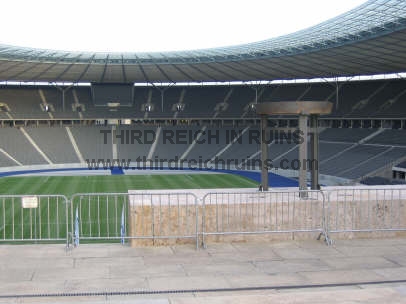
| The
Olympic Flame cauldron with its stylized decoration symbolizing the
journey of the torches to this spot. This engraving can still be faintly
seen on the support beams. (Official Report, the XIth Olympic
Games, Berlin 1936 (Berlin, 1937) |
 |
 |
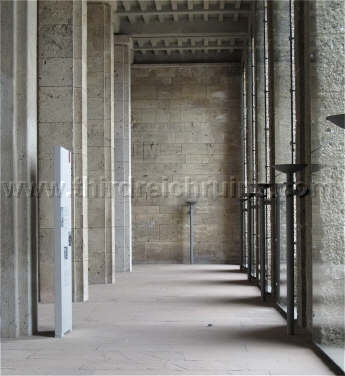
| Part of the colonnade
that runs around the outside of the stadium, showing the changes from
the renovation. (Official Report, the XIth Olympic Games,
Berlin 1936 (Berlin, 1937) |
 |
 |
| Hitler at the opening ceremony for the 1936 Olympic Games.
The modern view shows the location where the special seating area was built for
Adolf Hitler and visiting dignitaries (the different seating area on the
left). However, the remodeling of the stadium removed Hitler's own box. (Life
Collection). |
-
 |
 |
| Behind
the Stadium is the Maifeld (May Field), a large field for marching
reviews, gymnastics demonstrations, and May Day celebrations. The
entrance to the Stadium on this side was flanked by two equestrian
statues by sculptor Josef Wackerle. |
 |
 |
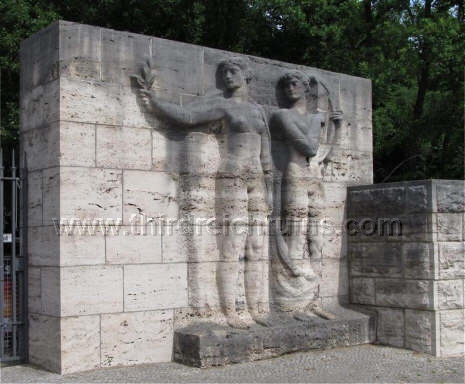
| Various
sculptures appear around the Olympic Stadium. Seen here are the Rosseführer
(horse holders) by
Josef Wackerle. Wackerle also designed works in Munich
and Schweinfurt.
(Werner Rittich,
"Architektur und Bauplastik der Gegenwart," Berlin, 1938; below -
"Kunst im Dritten Reich") |
 |
 |
 |
 |
| Sculptures
by Karl Albiker on the Olympic Stadium grounds - Diskuswerfer (discus
throwers) (above) and Staffelläufer (relay runners) (below).
(Werner Rittich,
"Architektur und Bauplastik der Gegenwart," Berlin, 1938) |
 |
 |
 |
 |
| Near the
stadium exit leading to the Haus
des Deutschen Sports complex is a large work by Willy Meller titled
"Siegesgöttin" (Goddess of Victory - Nike). Meller also
designed works in the Ordensburg
Vogelsang and for the Seebad
Prora. (above - "Kunst im Dritten Reich"; below -
Werner Rittich,
"Architektur und Bauplastik der Gegenwart," Berlin, 1938) |
 |
 |
Official
website for the Berlin Olympic Stadium
Click here to visit a site (in English and Norwegian)
about the Poststadion, where some of the Olympic soccer/football matches were held
(thanks to Terje Herman Solheim for info): http://www.facebook.com/media/set/?set=a.1990165596060.2120881.1300956648&l=64c82464f6&type=1
 Continue to the Haus der
Deutschen Sport and the Olympic Village Site
Continue to the Haus der
Deutschen Sport and the Olympic Village Site
Back to the Berlin page
Back to the Third Reich in
Ruins homepage
|